7 MyFitnessPal Alternatives Compared


MyFitnessPal is one of the most popular food logging apps and has one of the largest food databases.
While it can help you become more mindful of what you’re eating and track calories and macros, MyFitnessPal isn’t a perfect solution.
In this post, we’ll discuss a few alternatives that will help you reach your goals with less effort.
The Best MyFitnessPal Alternatives
Some of the biggest issues with MyFitnessPal are:
- Tracking effort: Most people get tired of manually logging each meal and quit or only log a portion of their food. This can lead to calorie underestimations.
- Tracking accuracy: Some of the meals in the database are user generated and inaccurate. You also may inaccurately estimate calories in a meal.
- Accountability: The only “accountability” feature is the community. However, occasional words of encouragement from strangers usually isn’t sufficient motivation to drive real change.
Given that MyFitnessPal falls short on tracking effort, accuracy, and accountability, these are the core features we’ll use to compare other alternatives.
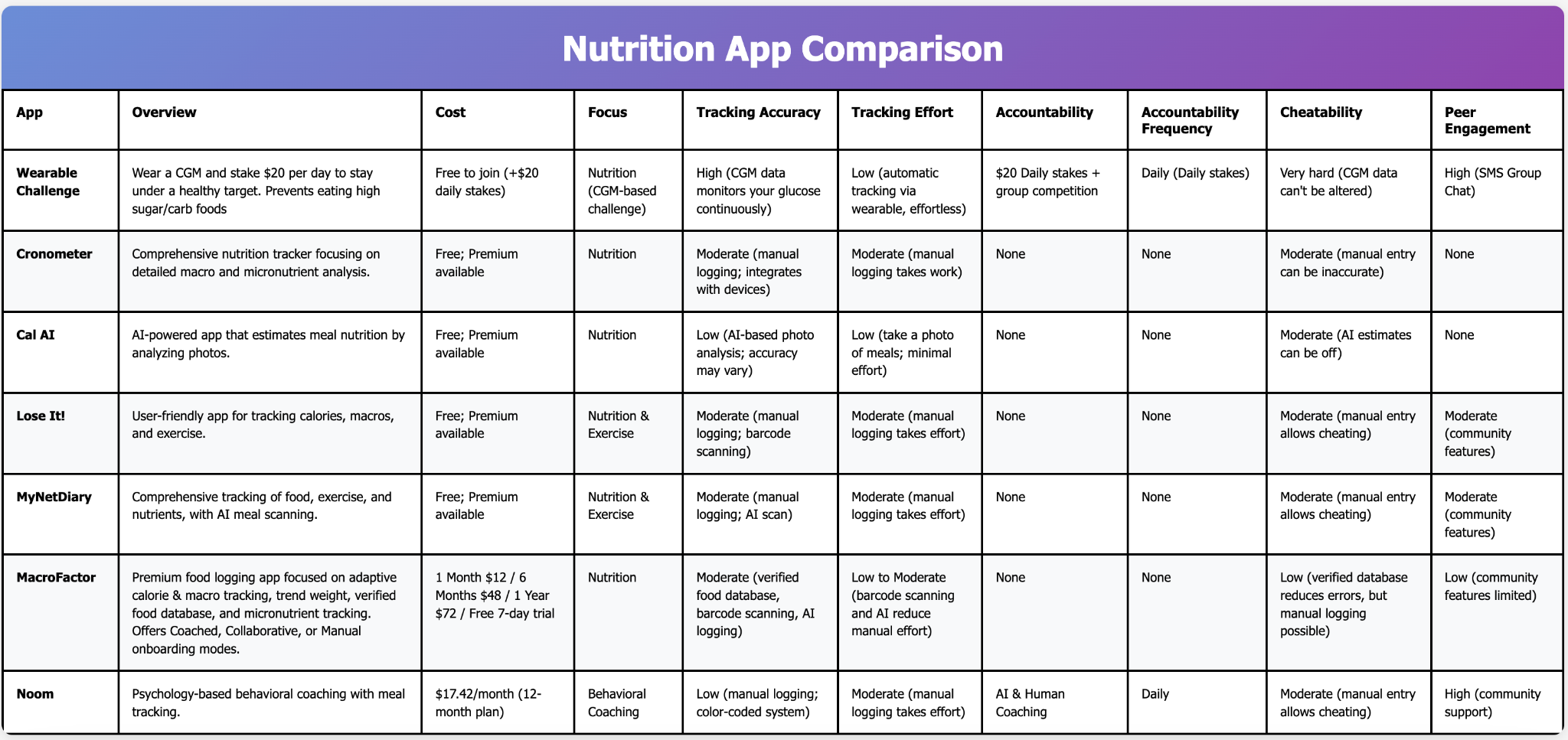
#1: Wearable Challenge
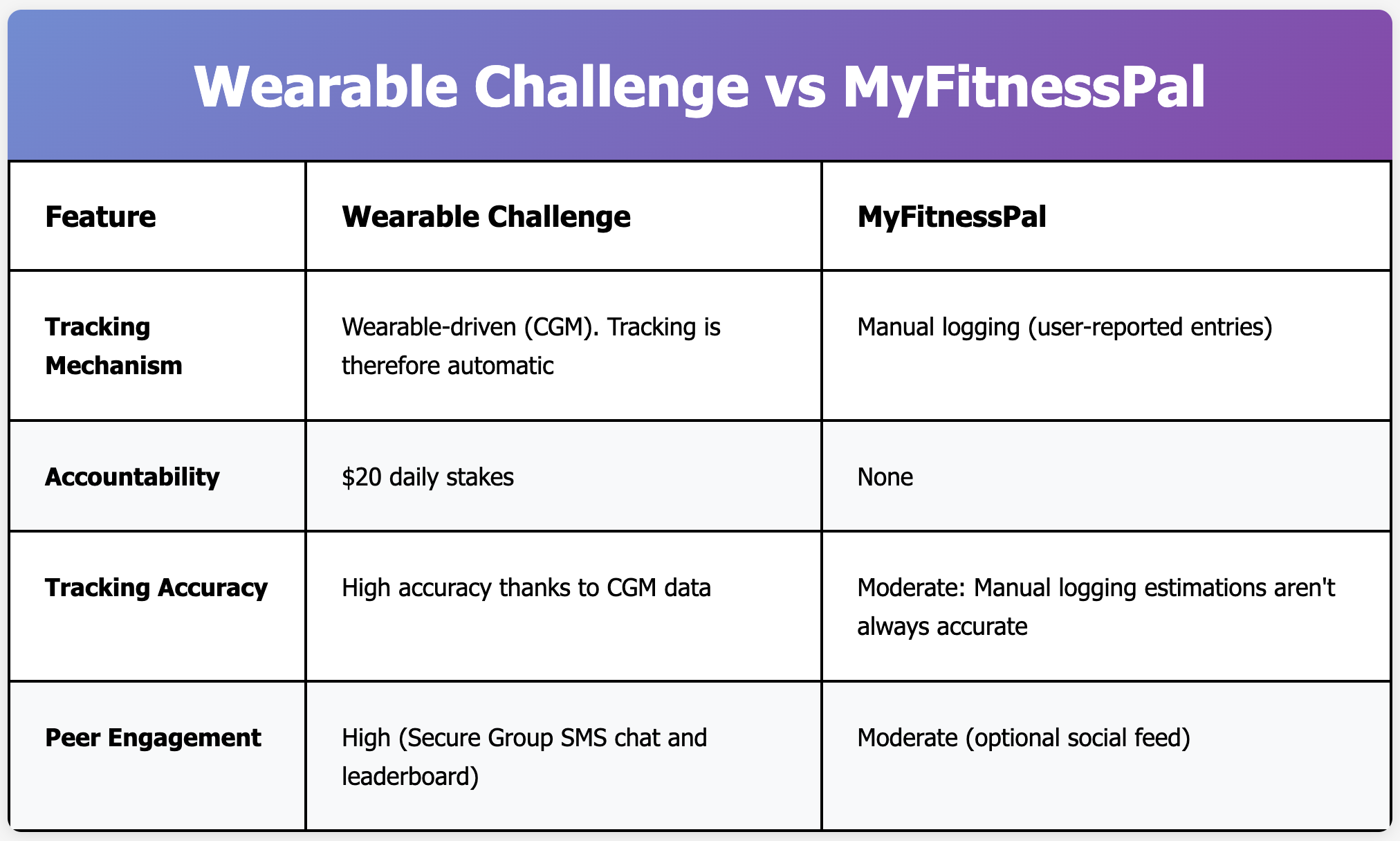
MyFitnessPal is designed to make you aware of what you’re eating, but manually logging each meal is tiresome and it doesn’t offer strong accountability.
Wearable Challenge solves these problems.
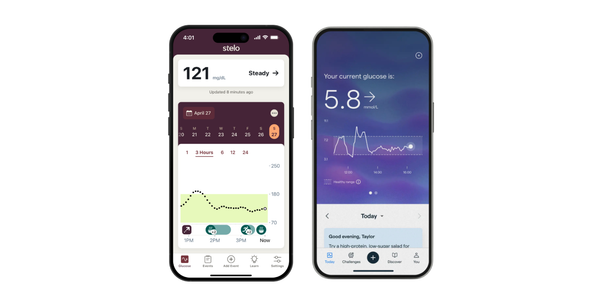
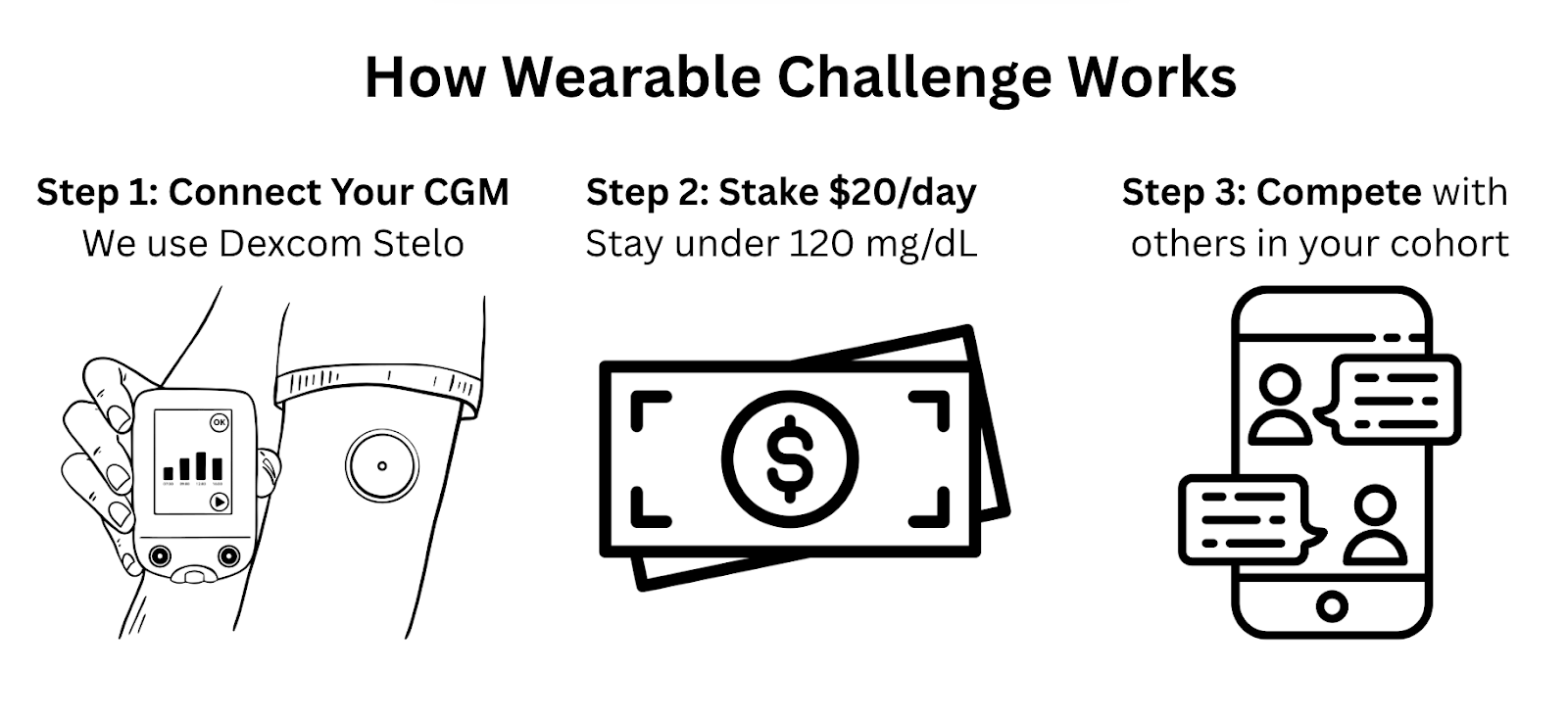
While it isn’t a meal tracking app, Wearable Challenge is a 14 day challenge where participants wear a CGM and stake $20 per day to keep their blood sugar under 120 mg/dL.
If your blood sugar spikes over 120 mg/dL, you lose your $20 for that day. Otherwise, Wearable Challenge is free to join.
The idea is that by limiting high sugar/carb foods that spike blood sugar, you’ll lose weight.
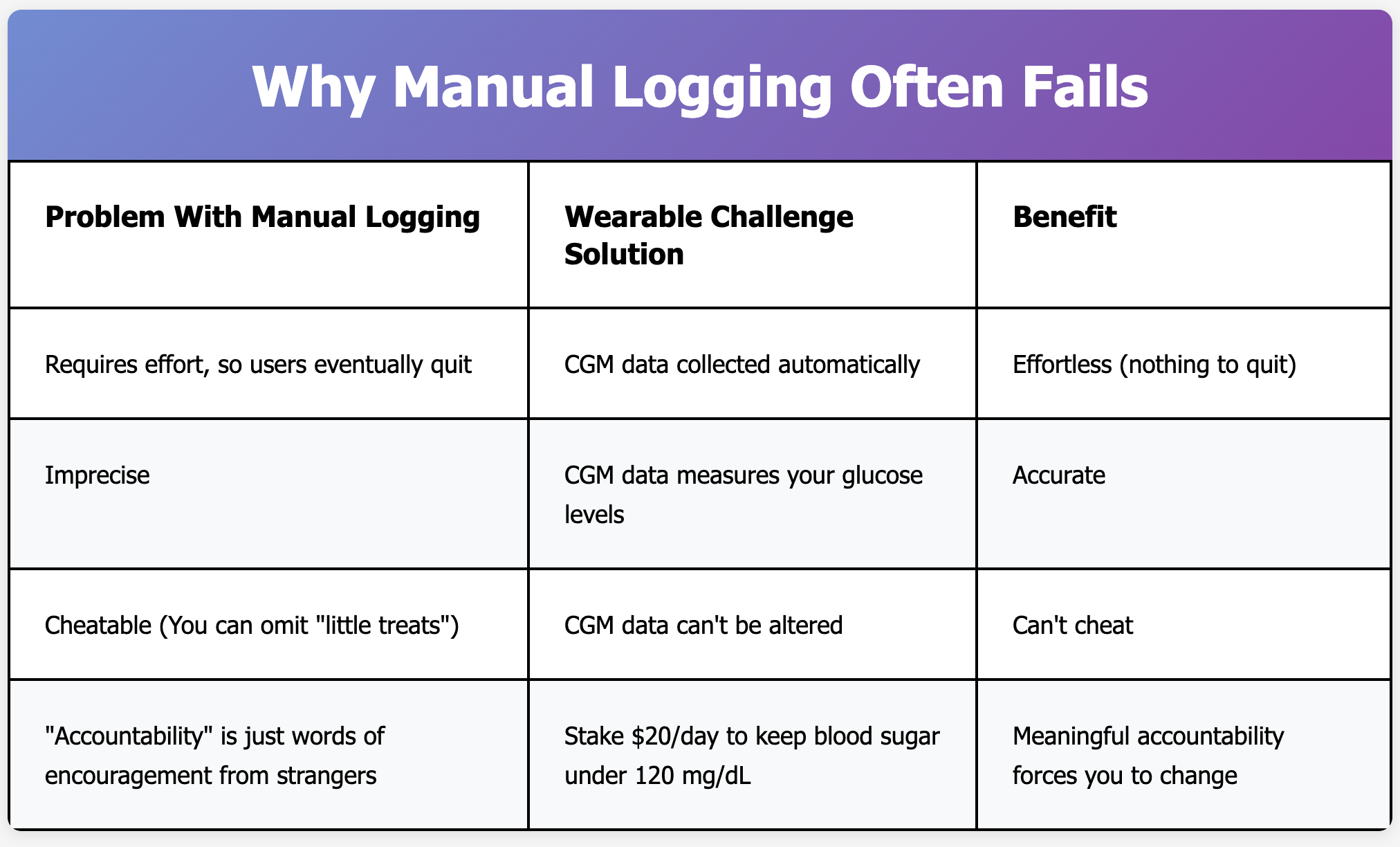
Wearable Challenge is arguably more effective than meal tracking apps for a few reasons:
- Effortless tracking: Unlike meal logging apps, the CGM automatically tracks blood sugar data for you. Therefore, participation requires zero effort on your part.
- Accurate data: Meal logging apps require you to estimate calories. CGM data shows your real blood sugar data.
- Immutable data: You might be tempted to omit little treats from your meal logging app. The CGM accounts for everything you ate.
- Meaningful Accountability: Words of encouragement from strangers usually isn’t sufficient accountability to drive change. $20 daily stakes is meaningful.
Unlike other apps, where you pay a flat fee to join regardless of how well you adhere to your new plan, Wearable Challenge only charges you when you slip up.
Your future self thanks you for joining Wearable Challenge today.
Wearable Challenge vs MyFitnessPal:
Pricing Tiers:
#2: Cronometer
Cronometer is a nutrition-focused tracking app that’s very similar to MyFitnessPal, but slightly more advanced.
It tracks over 80 micronutrients in addition to calories and macros, giving a more complete picture of nutrition. You can log food manually, scan barcodes, or import recipes. The app also integrates with wearable devices to capture activity data and sync biometric metrics.
Key Differentiators:
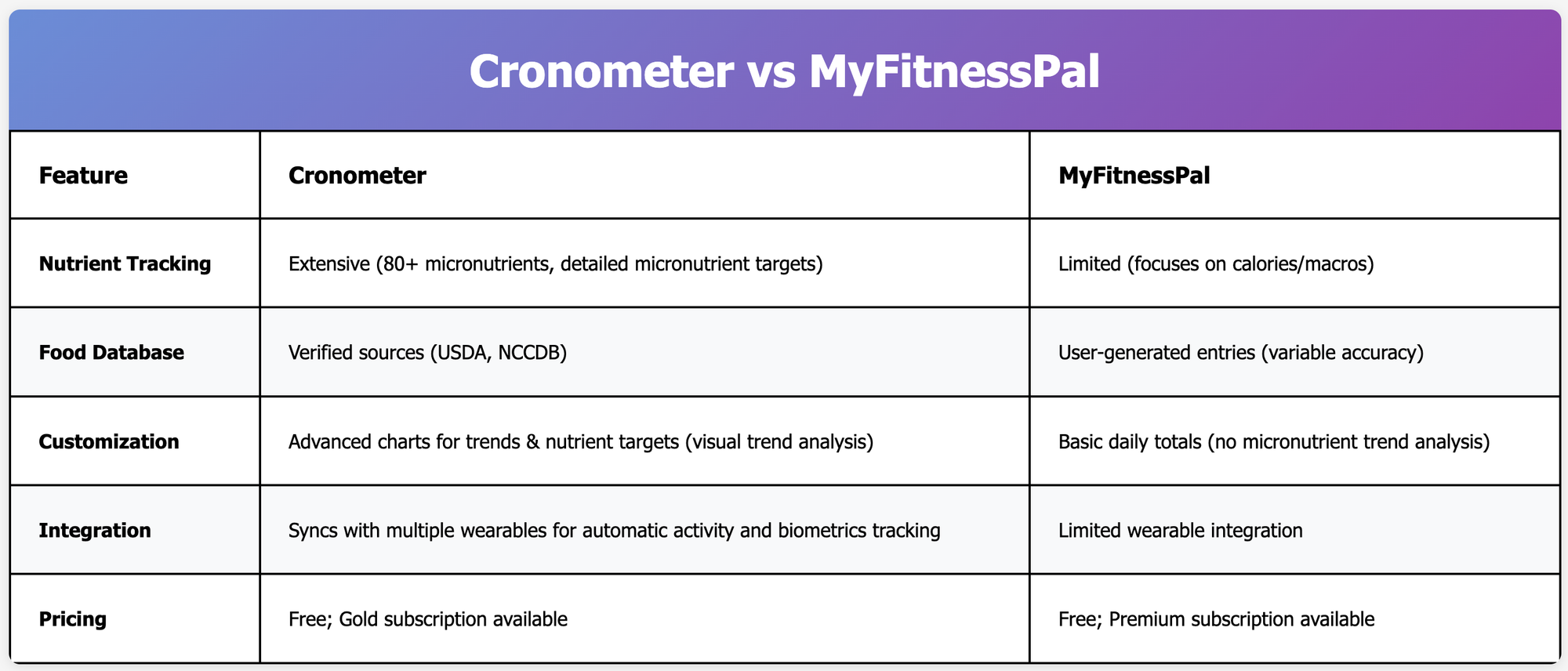
- Comprehensive Nutrient Tracking: Cronometer tracks 80+ micronutrients (vitamins, minerals) compared to MyFitnessPal’s focus on calories/macros (basic macro tracking only).
- Verified Food Database: Uses USDA and NCCDB sources for accuracy, unlike MyFitnessPal’s user-submitted entries which can be inconsistent.
- Customizable Reports: Offers charts for nutrient intake, trends over time, and nutrient targets (MyFitnessPal mostly shows simple daily totals).
- Integration with Wearables: Syncs with Apple Health, Fitbit, Garmin, and other devices to provide automatic activity and biometrics tracking (MyFitnessPal’s wearable integration is limited).
Cronometer vs MyFitnessPal:
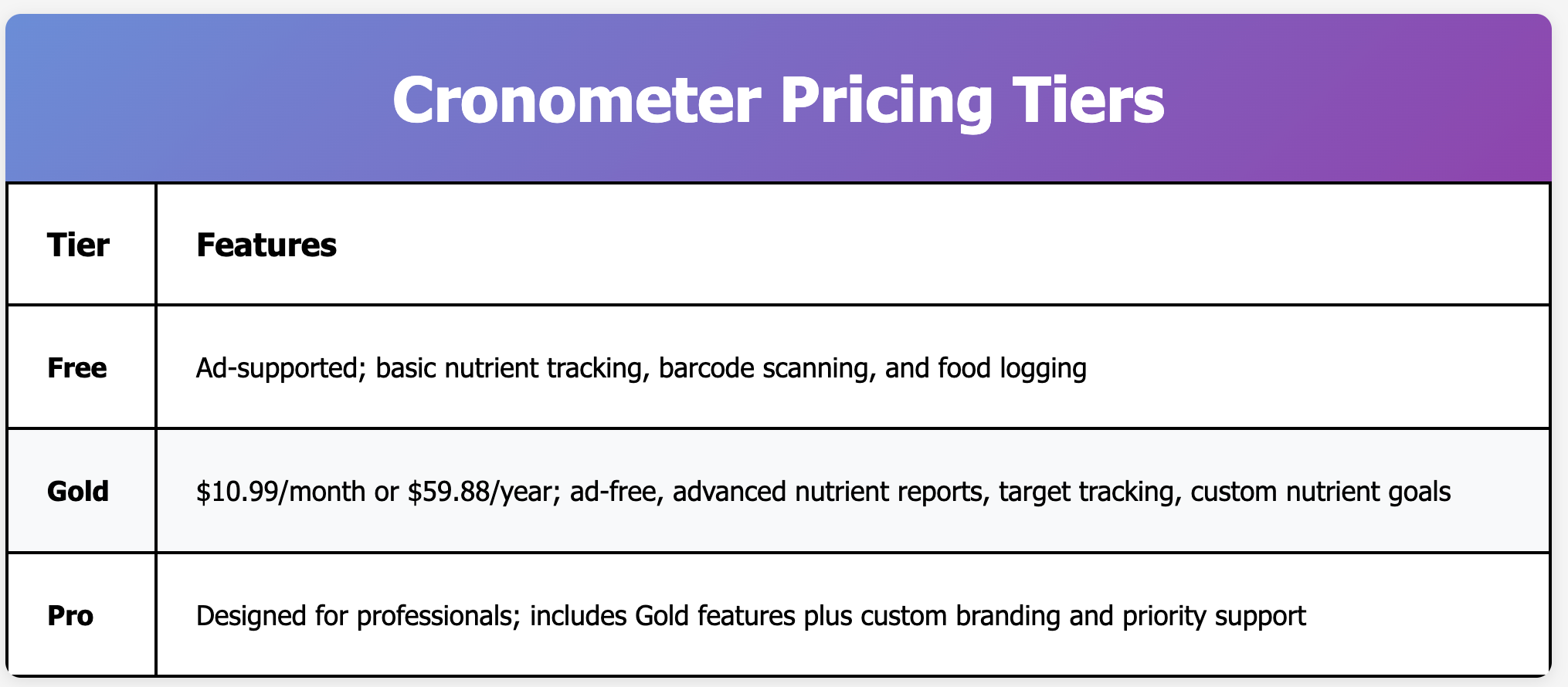
Cronometer Pricing Tiers:
#3: Cal AI
Cal AI uses artificial intelligence to simplify meal logging.
Users can snap a photo of their food, scan a barcode, or describe their meal, and the app estimates calories, protein, carbs, and fats. AI models are trained on large datasets of labeled food images and nutritional information to predict the content of meals.
Accuracy of AI Recognition:
The AI analyzes the visual features of food (shape, color, texture) and cross-references them with its database to estimate portion size and nutrient content.
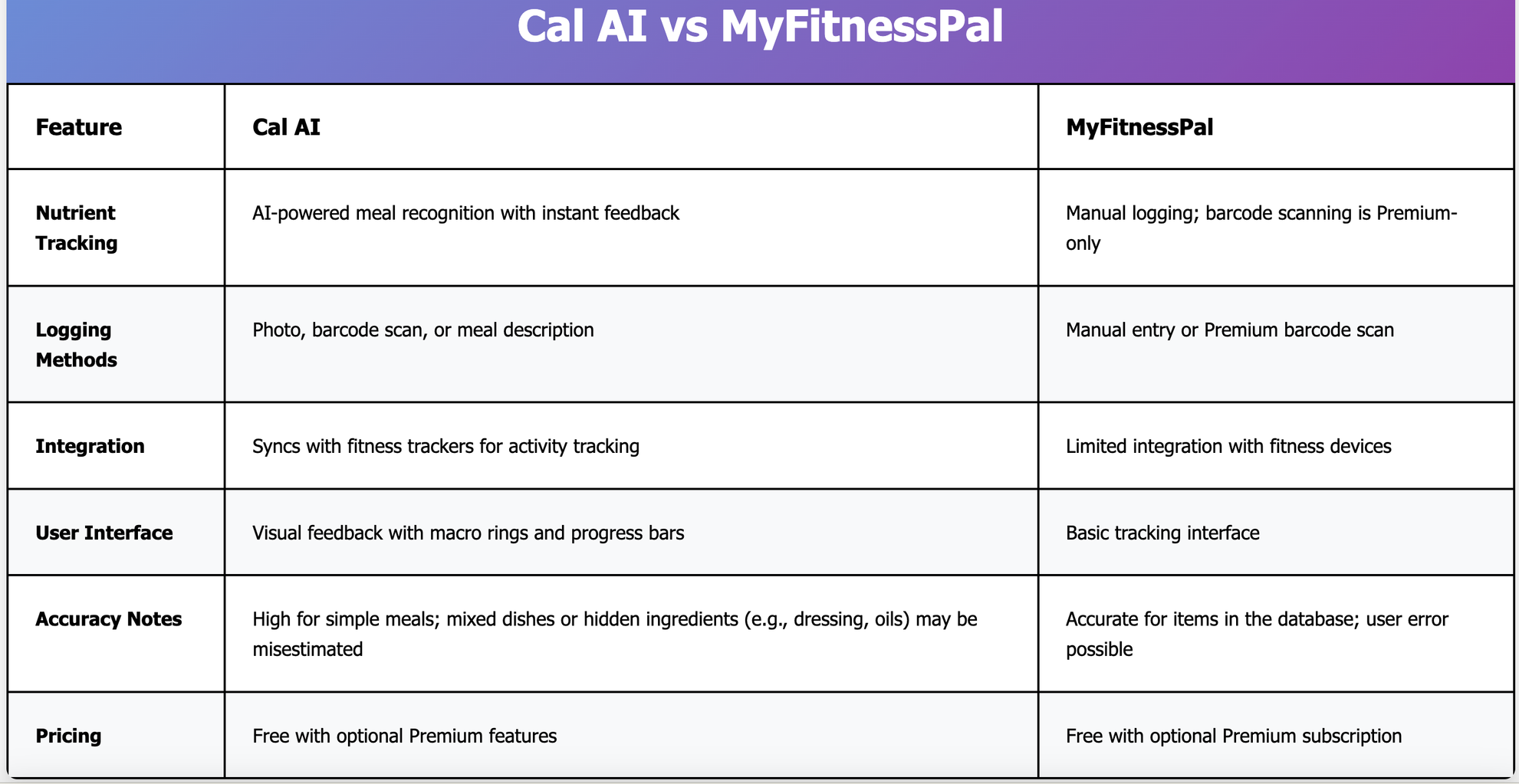
Therefore, it works well for simple meals (e.g., a grilled chicken breast with broccoli, a bowl of cereal) are usually very accurate.
However, it can be inaccurate in these scenarios:
- Mixed dishes (e.g., casseroles, stews, or meals with sauces) can be misclassified or portion sizes misestimated.
- Hidden ingredients like salad dressing, cooking oils, or added sauces are often invisible in photos, which can lead to underestimated calories and fat content.
- Highly processed or unusual meals.
While it isn’t a perfect solution, it may be better than more manual apps as users are at least more likely to use it for a longer duration.
Key Differentiators:
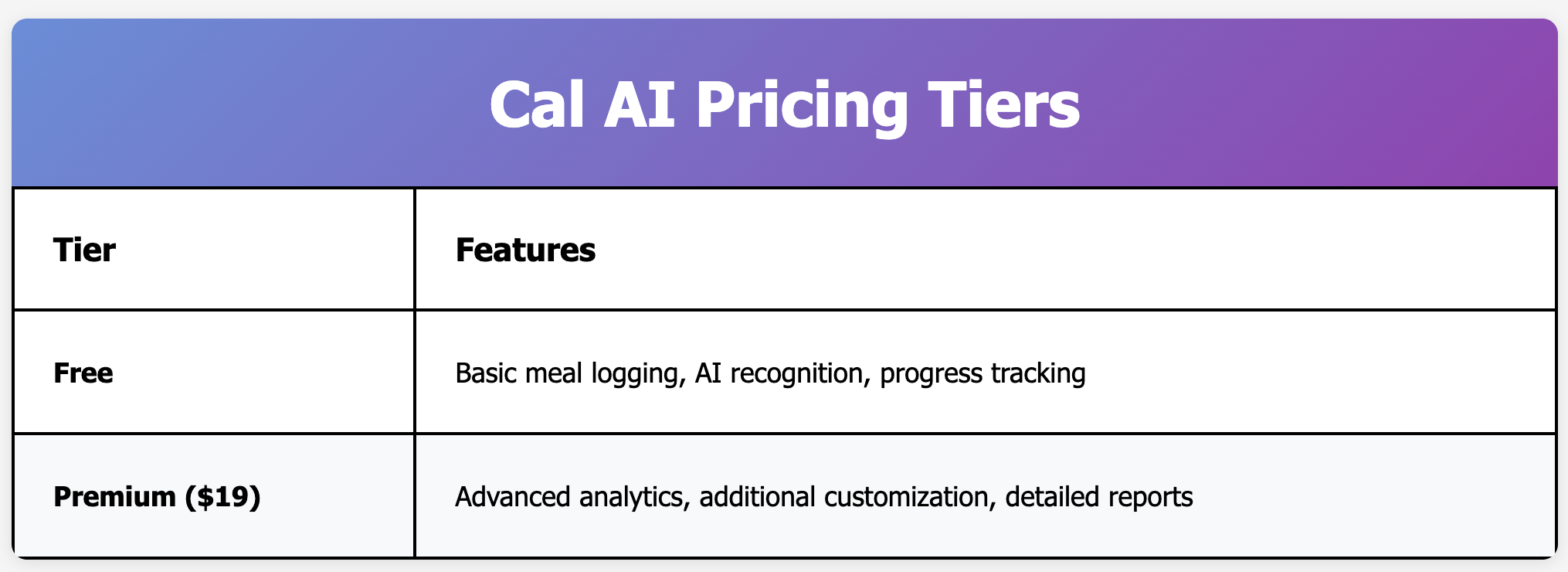
- AI-Powered Meal Recognition: Provides near-instant calorie and macro estimates (MyFitnessPal requires manual entry; barcode scanning is Premium-only).
- Multiple Logging Methods: Photo, barcode, or text description for flexibility.
- User-Friendly Interface: Visual feedback with macro rings and progress charts.
Cal AI vs MyFitnessPal:
Cal AI Pricing Tiers:
#4: Lose It!
Lose It! is a calorie-tracking and weight management app designed to help users set personalized weight loss goals and build healthy habits through structured logging of food, exercise, and progress.
The onboarding process begins with inputting age, weight, height, activity level, and target goals.
Then, the app generates a customized daily calorie and nutrient plan.
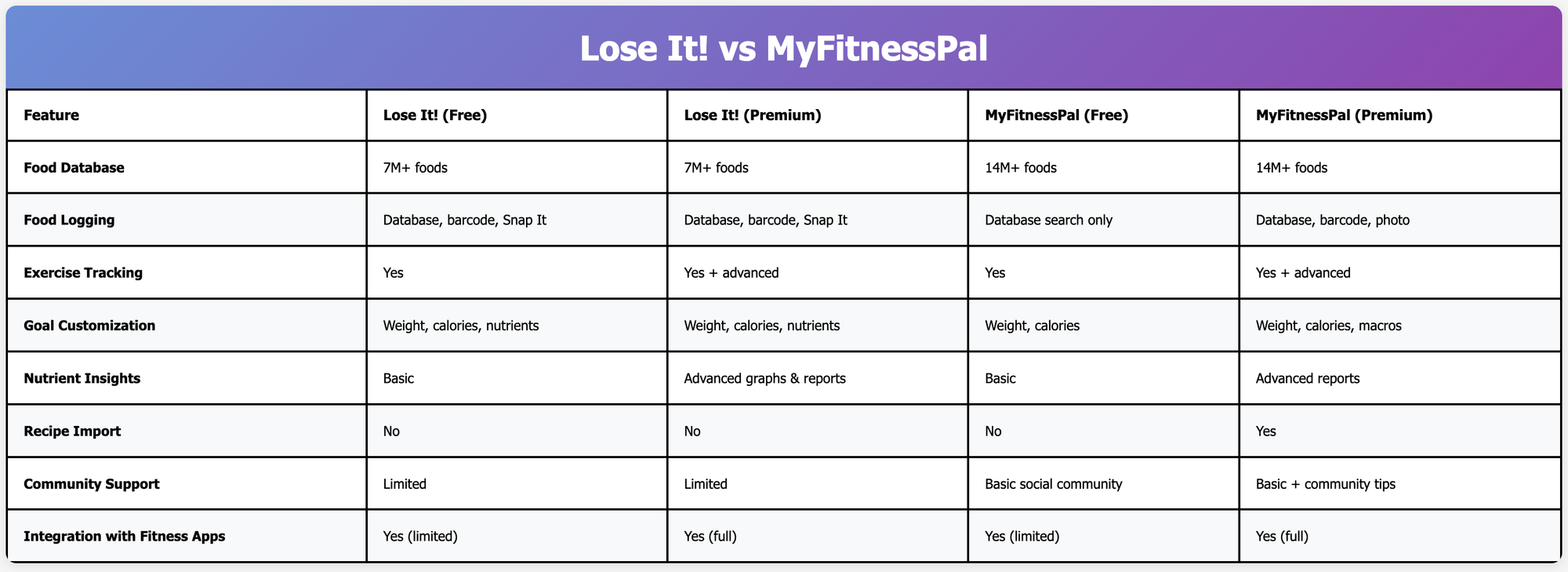
While both MyFitnessPal and Lose It! offer food logging on their free tiers, only Lose It! offers barcode scanning, “Snap It” (record via camera) and meal planning in the free version.
Key Differentiators:
- Onboarding and Personalization: Lose It! creates a tailored plan from the start based on user data, whereas MyFitnessPal offers a simpler setup, mostly focused on calorie goals.
- Food Logging: Lose It! allows database search, barcode scanning, and photo logging in free and premium. MyFitnessPal reserves many of those features for Premium only.
- Goal Tracking: Lose It! tracks weight, exercise, and body measurements with optional advanced nutrient insights; MyFitnessPal tracks calories, macros, and exercise.
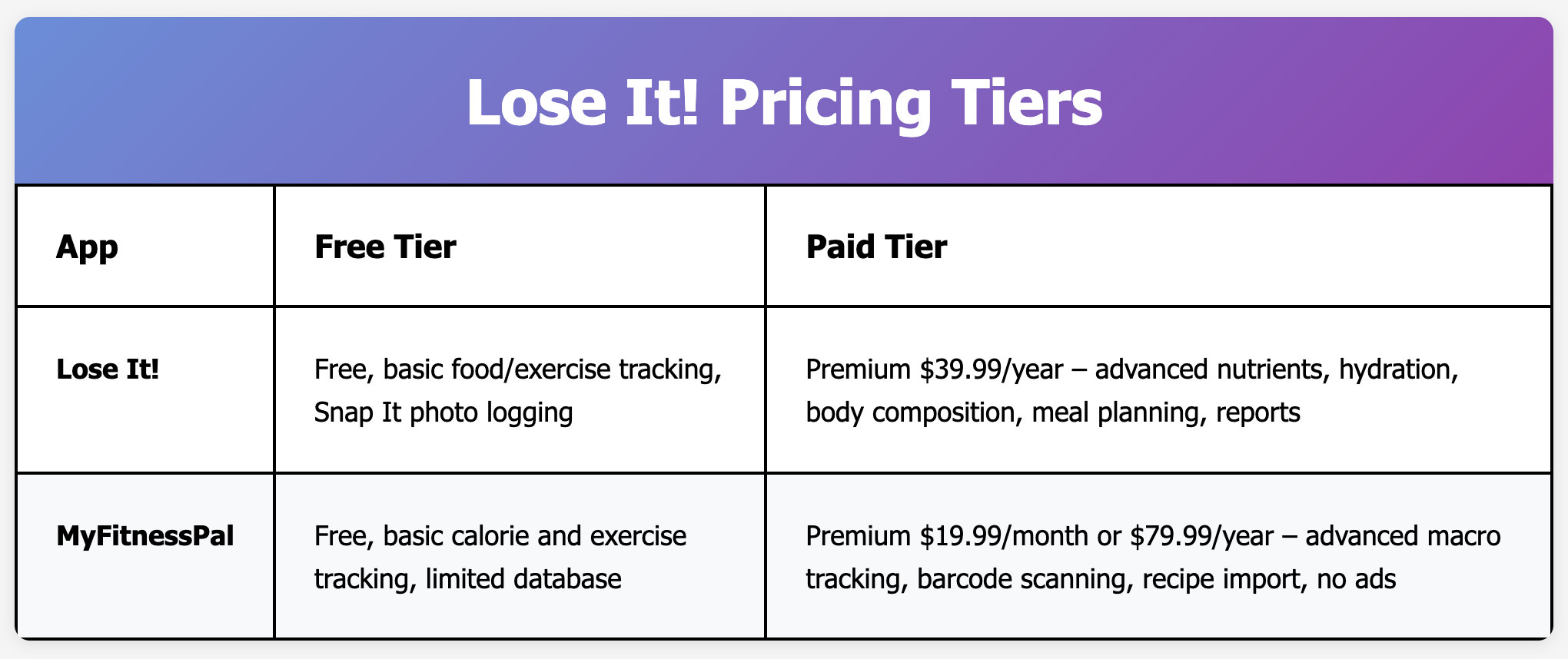
- Premium Features: Both apps offer advanced tracking, but Lose It! Premium emphasizes holistic tracking and visual progress reports. This can be a pro or a con for people depending on how complex they want to track their health goals.
Lose It! vs MyFitnessPal
Lose It! Pricing Tiers:
#5: MyNetDiary
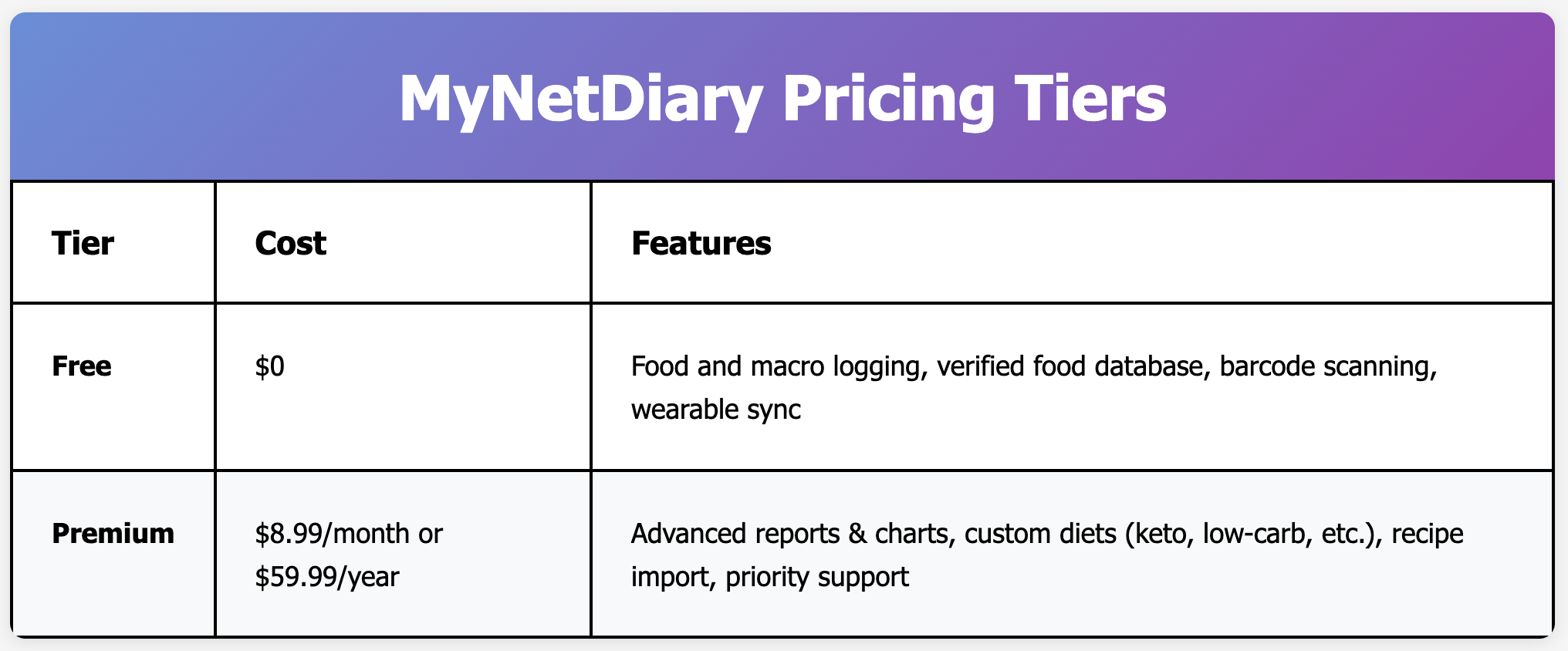
MyNetDiary is a calorie and macro tracking app with a curated food database that’s actively verified by nutrition professionals.
Unlike MyFitnessPal, which leans heavily on community-submitted entries, MyNetDiary’s foundation database is vetted for accuracy across both free and premium plans.
The app still allows custom food entries, but those do not automatically enter the public database unless reviewed.
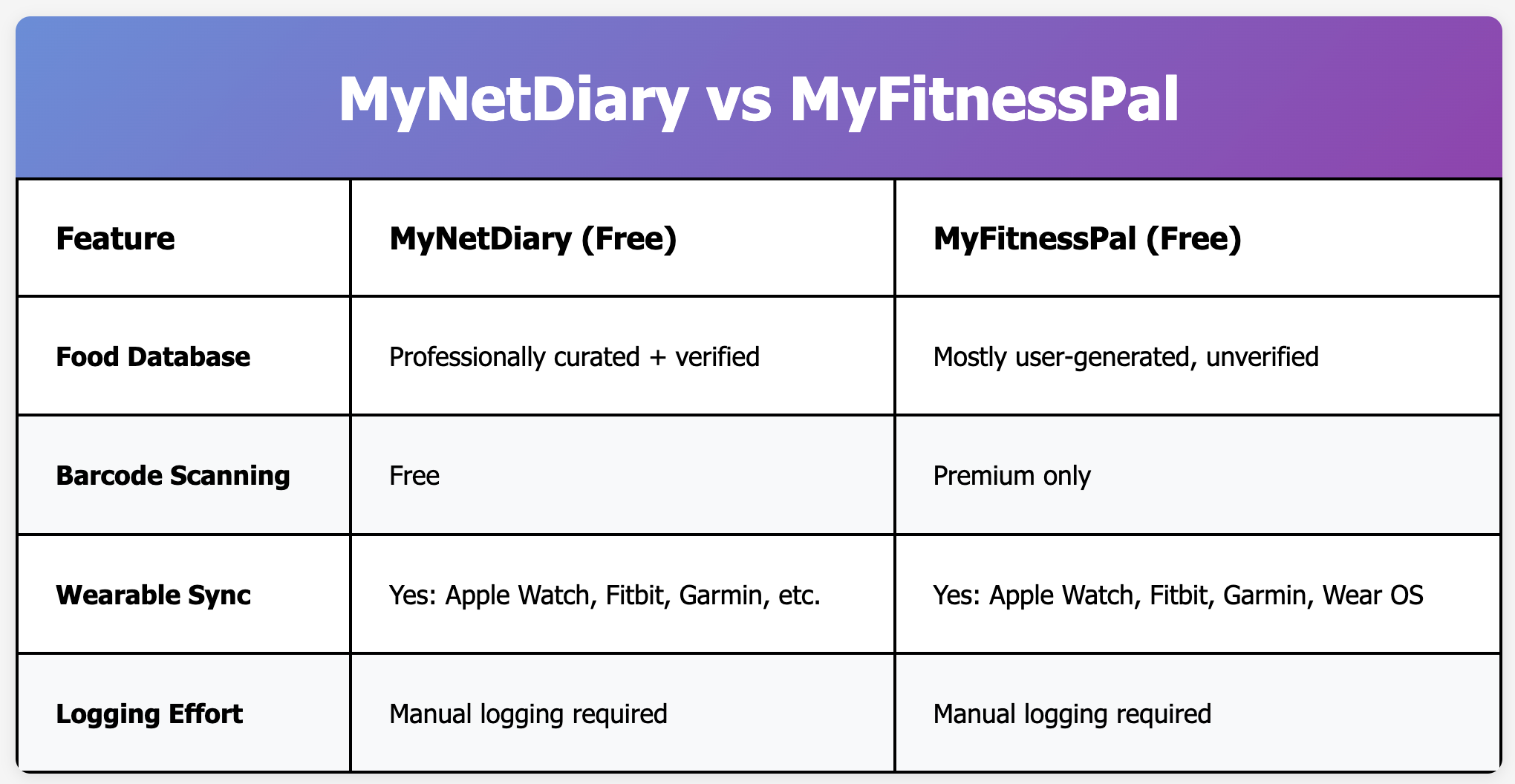
MyNetDiary also offers barcode scanning for free, integrates with most major wearables (Apple Watch, Fitbit, Garmin), and syncs with continuous glucose monitors via Apple Health.
Key Differentiators:
- Verified food database (MyNetDiary’s entries are professionally reviewed, not user-generated)
- Barcode scanning is available for free (MyFitnessPal requires Premium for this)
- CGM integration via Apple Health (MyFitnessPal supports via Google Health Connect)
- Cleaner interface and fewer duplicate entries
- Manual effort still required for most meals, just like MyFitnessPal
MyNetDiaries vs. MyFitnessPal
Pricing Tiers:
#6: MacroFactor
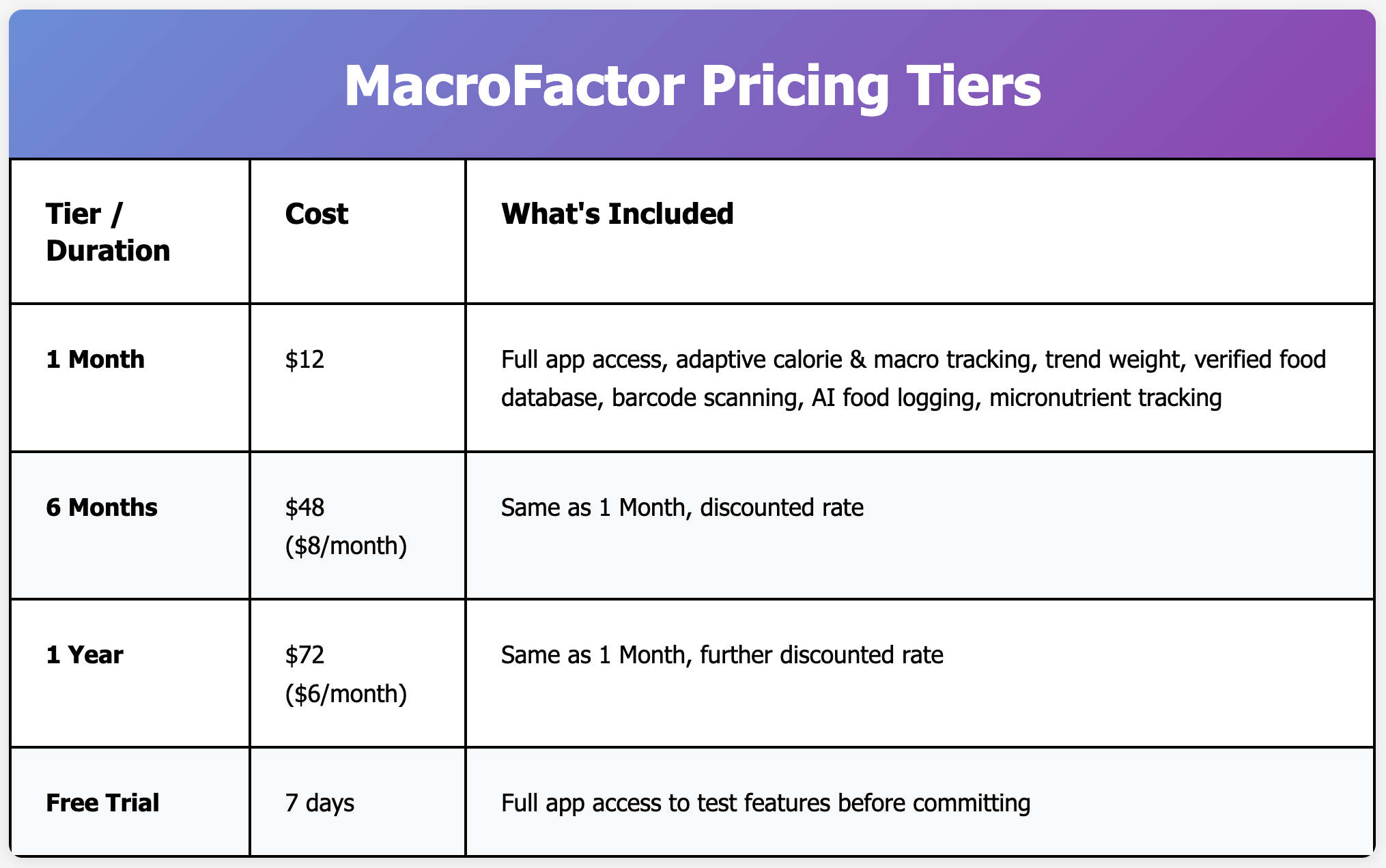
MacroFactor is a premium food logging app, though it focuses on macros rather than just caloric intake, making it ideal for those trying to bulk, cut, or recomp.
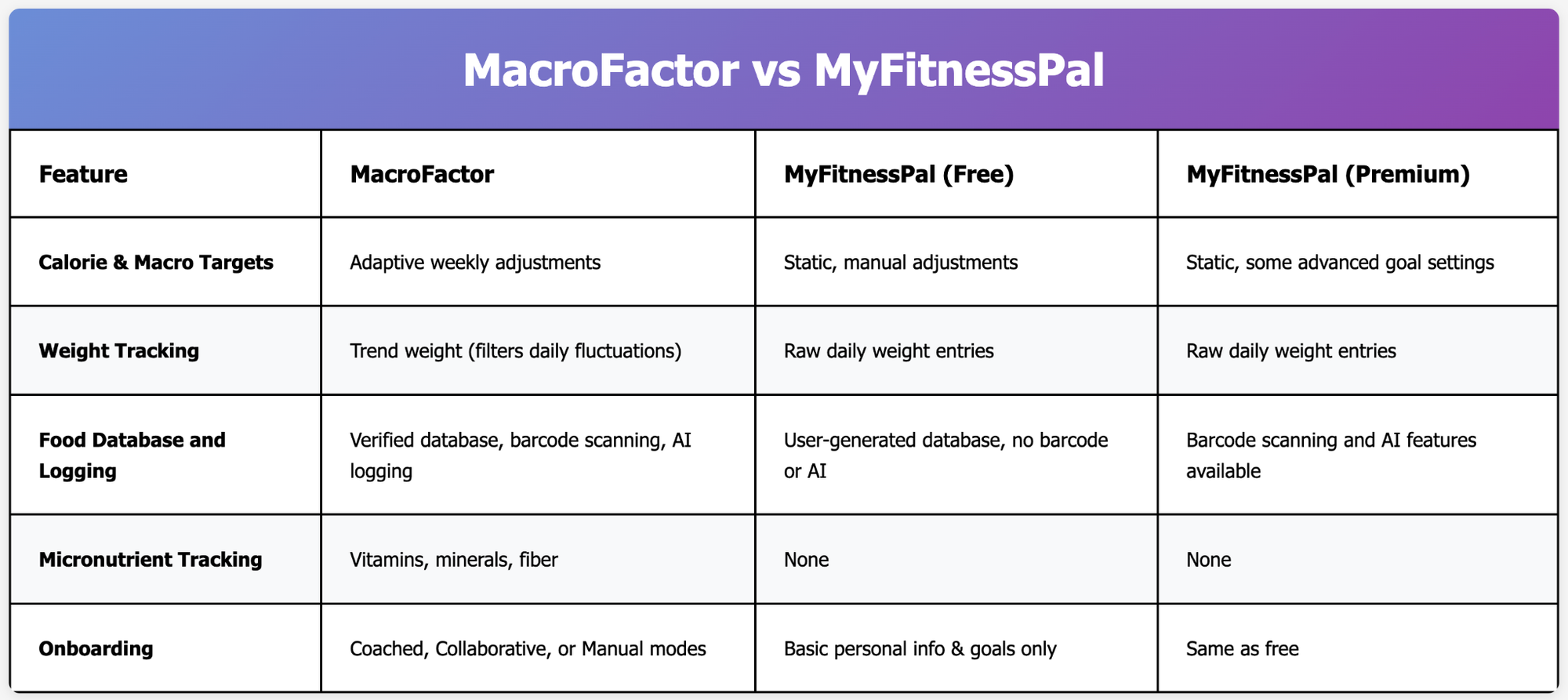
Unlike MyFitnessPal, which provides static calorie targets unless you adjust them manually, MacroFactor dynamically adapts your calorie and macronutrient recommendations each week based on your trend weight and progress.
The app also accounts for natural fluctuations in body weight (like water retention or sodium intake) to give you a clearer picture of real progress.
Onboarding is also more science-driven.
Instead of simply asking for height, weight, and activity level (like MyFitnessPal does), MacroFactor gives you multiple coaching modes to choose from, including a “Coached” mode where the app calculates your calorie/macro needs for you, a “Collaborative” mode where you set targets with some guidance, and a “Manual” mode if you want full control.
This allows beginners and advanced users alike to start with the level of input that makes the most sense for them.
Its verified food database minimizes the errors and duplicates common in user-generated databases like MyFitnessPal’s.
Additionally, barcode and nutrition label scanning is available at all tiers. MacroFactor also tracks micronutrients (vitamins, minerals, and fiber), which isn’t available in MyFitnessPal.
Key Differentiators:
- Adaptive calorie and macro targets: MacroFactor automatically adjusts weekly based on your trend weight. MyFitnessPal’s targets are mostly static unless you change them manually.
- Trend weight tracking: Smooths out daily fluctuations to show real progress. MyFitnessPal uses raw daily weight entries.
- Verified food database: More accurate and curated than MyFitnessPal’s largely user-generated database.
- Barcode scanning included for all users: MyFitnessPal restricts this to Premium accounts.
- Micronutrient tracking: MacroFactor tracks vitamins, minerals, and fiber, whereas MyFitnessPal does not.
- Onboarding options: MacroFactor offers Coached, Collaborative, or Manual modes to tailor recommendations from the start. MyFitnessPal only asks basic personal info and goals.
MacroFactor vs MyFitnessPal
MacroFactor Pricing Tiers:
#7: Noom
Noom is a psychology-based weight-loss app designed to help you build sustainable healthy eating habits rather than following a restrictive diet.
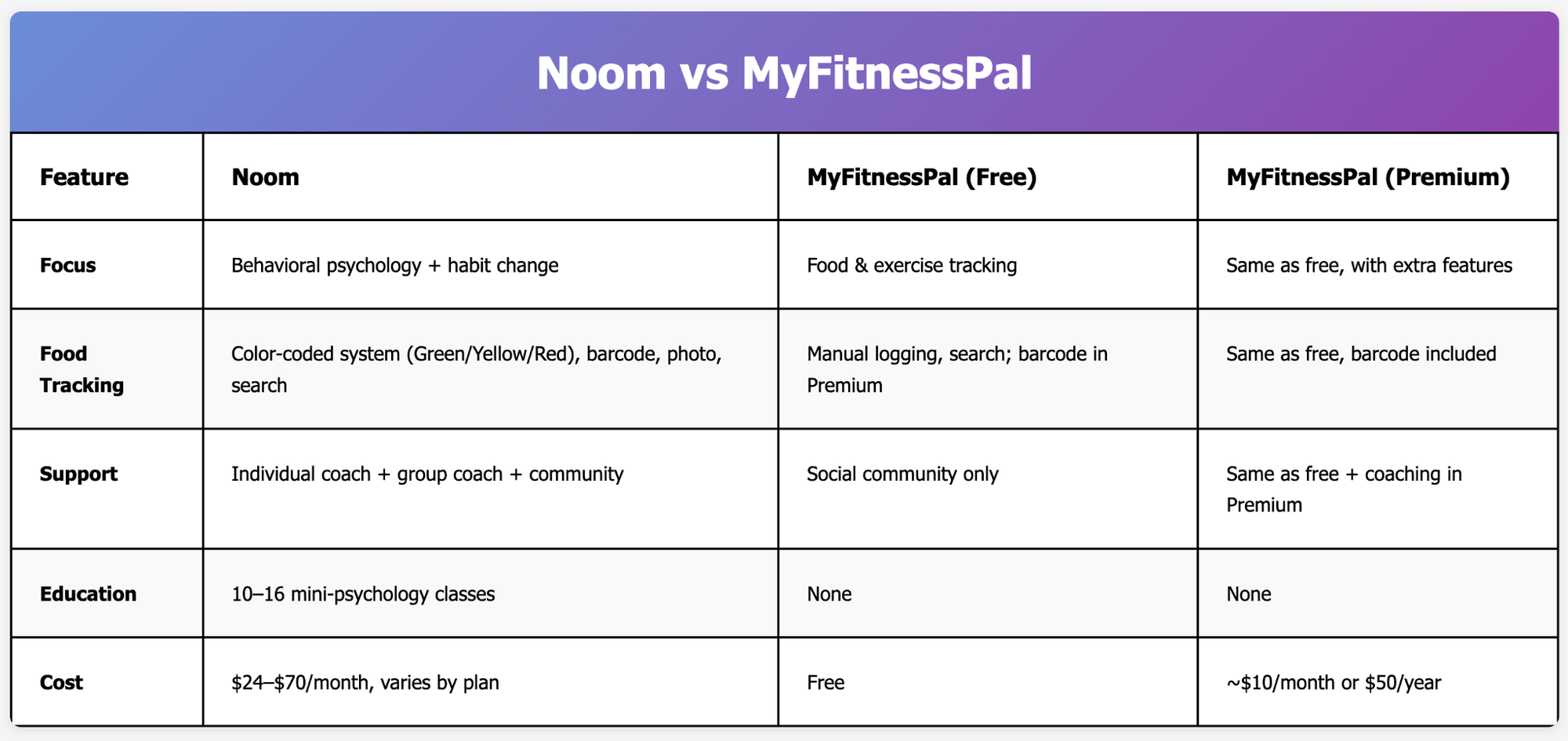
The program combines daily calorie tracking, a color-coded food system (Green, Yellow, Red), activity tracking, and personalized support from both individual coaches and group coaches.
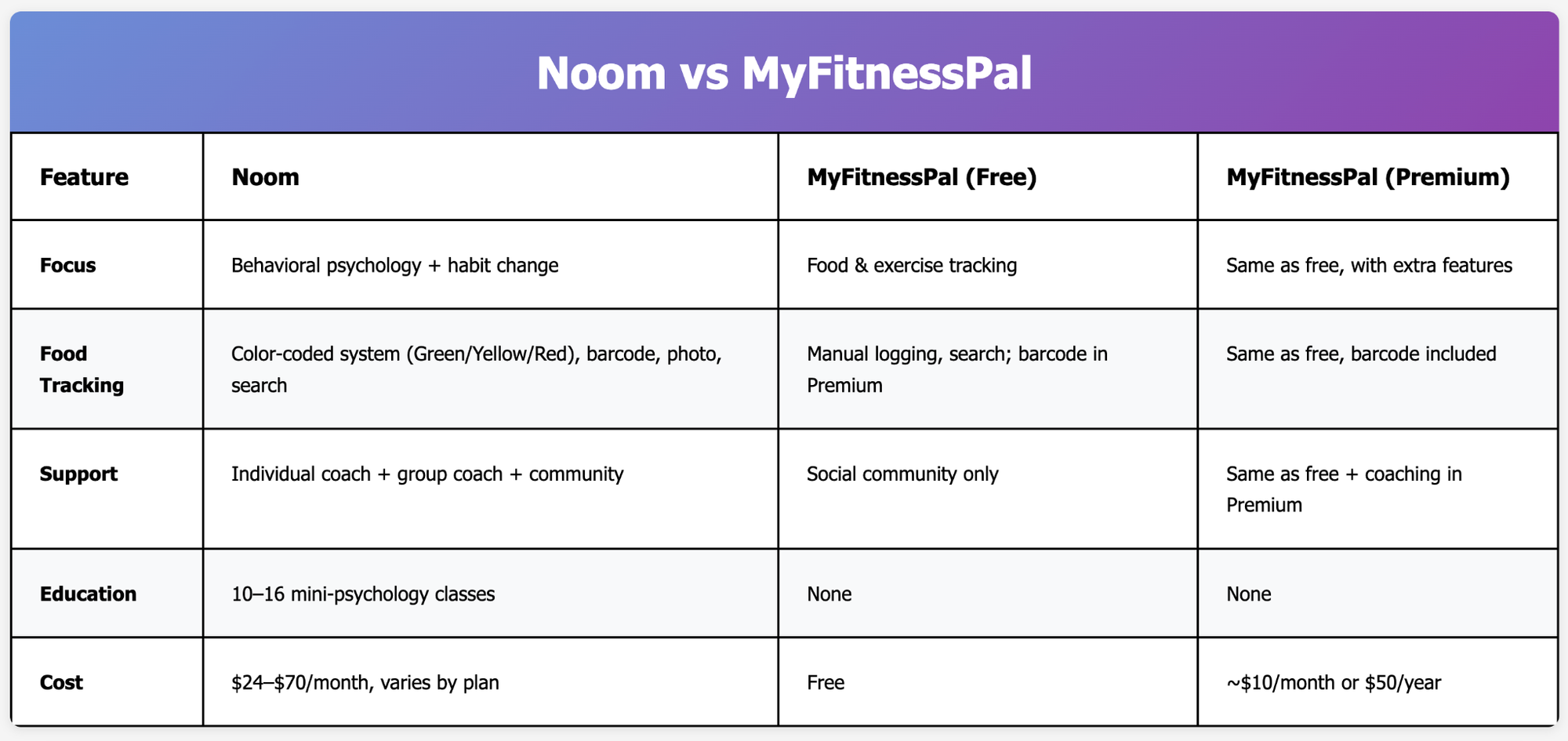
Unlike MyFitnessPal, which primarily serves as a tool to log food, exercise, and weight, Noom emphasizes behavioral change, using daily mini-classes, motivational feedback, and a community to reinforce healthier habits over time.
Noom users typically start by completing a quiz about their goals, lifestyle, and personal habits (this can take up to 30 minutes, so expect it to be very thorough).
Using the onboarding information, it creates a customized plan.
Users are encouraged to weigh in daily, log their meals, track water, and complete 5-15 minute psychology-based lessons designed to help them understand and improve their relationship with food.
Activity integration with over 20 fitness-tracking devices allows for a more complete picture of calories burned.
The emphasis on behavioral psychology and long-term habit formation is what sets Noom apart from more traditional calorie-counting apps.
Key Differentiators:
- Psychology-Based Approach: Noom focuses on changing habits and behavior with daily mini-classes and motivational feedback, while MyFitnessPal is primarily a calorie and exercise tracker.
- Structured Onboarding: Noom starts with a detailed quiz about goals, lifestyle, and habits to create a personalized plan, whereas MyFitnessPal has a quick setup with basic weight and calorie targets.
- Support System: Noom provides individual coaches, group coaches, and a community for accountability. MyFitnessPal’s support is limited to its user community and optional premium coaching.
- Food Tracking: Noom uses a color-coded system (Green, Yellow, Red) to encourage healthier choices, while MyFitnessPal focuses on calories and macronutrients.
- Activity Integration: Noom connects with over 20 devices for comprehensive tracking, whereas MyFitnessPal integrates with fewer.
Noom vs. MyFitnessPal
Noom Pricing Tiers:
Choose The Right MyFitnessPal Alternative For You
The biggest problem with MyFitnessPal and many of its alternatives is that they all require manual food logging.
The problem with food logging is that:
- You probably won’t stick with it long term
- It’s often inaccurate if you’re entering meals yourself
- It’s easy to omit little snacks that really add up.
Additionally, most of the “accountability” offered by MyFitnessPal alternatives is simply support and coaching.
Yet for many people, words of encouragement aren't impactful enough to drive you to change your habits.
Instead, we built Wearable Challenge.
It’s a CGM based challenge where you bet $20 per day to stay under 120 mg/dL.
The CGM data makes it impossible to cheat yourself, and with daily stakes, you’ll be very motivated to make every day count.
Join Wearable Challenge to change today.